
Add Your Heading Text Here
Rethinking the Data Terminal: Why Every Investment Professional Doesn't Need a Premium Data Terminal
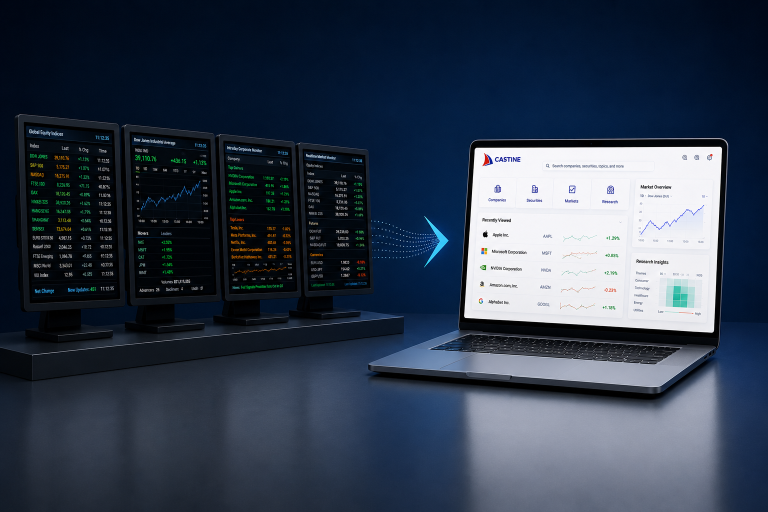
For more than three decades, premium data terminals have defined how investment professionals consume information. Bloomberg Terminal, LSEG Workspace, FactSet, and S&P Global Capital IQ Pro became foundational to research, portfolio management, compliance, and reporting — not just applications, but the operating backbone of the industry. Castine RMS was built for the era that follows: the enterprise research infrastructure that lets firms extend the value of those terminals to the people who don’t need one.
The premium data terminal architecture served the industry well. But investment management is entering a different era. Fee compression continues to squeeze active managers, passive strategies keep taking share, regulatory obligations keep expanding, and artificial intelligence is changing how professionals discover information and make decisions.
The question firms now face isn’t which terminal to buy. It’s how investment knowledge should be organized, governed, and made accessible — across people, applications, and AI agents.
Who Actually Needs a Premium Terminal?
This isn’t an argument for eliminating Bloomberg or any premium data platform. These remain best-in-class tools for portfolio managers, traders, and quant teams who need real-time pricing on less liquid assets, fixed-income modeling, derivatives analytics, and execution workflows.
It’s an argument for being precise about where these platforms create differentiated value — and where they don’t.
Most investment professionals spend their day reading research, reviewing filings, documenting decisions, and preparing committee materials. That work demands high-quality information. It does not require the industry’s most expensive desktop platform. It requires research infrastructure: something that securely connects external content, proprietary research, enterprise knowledge, workflow, and AI. That is the role Castine RMS is built for — stepping in where a terminal isn’t needed, and complementing market data terminals as the platform where investment knowledge is centralized, governed, and made reusable across the firm.
The Economics Have Changed
Active management fees keep falling while expectations for performance, transparency, and reporting keep rising. Meanwhile, terminal costs keep climbing:
Platform | Typical Annual Cost per User |
Bloomberg Terminal | $30,000–32,000 |
Refinitiv Workspace | $15,000–20,000 |
FactSet Workstation | $16,000–22,000 |
S&P Global Capital IQ Pro | $16,000–22,000 |
AlphaSense (enterprise) | $15,000–25,000 |
At scale, this becomes one of the largest recurring line items on the technology budget. Compare this to Castine, at approximately $6,000 per user. (Castine’s offering is a part of a larger suite that has different pricing options for different types of user.)
Investment Manager | Terminal Users | Annual Spend | Potential Savings (75% reduction) |
Small | 25 | $775,000 | $387,500 (update) |
Medium | 100 | $3.1 million | $1.55 million |
Large | 500 | $15.5 million | $7.75 million |
Nobody disputes the value premium platforms deliver. The real question is whether every licensed seat needs their full capability. A typical research analyst spends much of the day reading broker research, reviewing transcripts and filings, exporting data to Excel, and collaborating with colleagues — work that rarely requires the depth that justifies terminal-level pricing. The strategic question is shifting from “how many terminals should we buy?” to “which users genuinely require premium market data?”
Legacy Platforms Weren’t Built for This Era
Most premium terminals predate cloud-native software, enterprise APIs, and AI as core infrastructure. They remain outstanding data sources, but they carry the closed architecture of a different decade: desktop-centric, proprietary, difficult to integrate, and — critically — never designed to represent a firm’s own investment process.
Every manager develops proprietary methodologies, taxonomies, and committee workflows over years. That’s intellectual property and competitive advantage, not administrative overhead. Technology should adapt to that process. Firms shouldn’t have to adapt their process to the limits of their technology.
The Hidden Cost Is Bigger Than the License
The subscription is only one line item. Over time, most firms accumulate fragmented research ecosystems: research in one system, notes in another, email in Outlook, committee papers in SharePoint, market data in one terminal, broker research in another. Each addition brings its own search experience, permission model, and governance burden — fragmenting knowledge and making it harder to reuse or put to work with AI.
There’s a structural risk too. As the industry concentrates around a small number of data providers, an outage or data-quality issue at any one of them can disrupt research, compliance, and trading across thousands of firms at once. The fix isn’t abandoning premium providers — it’s building an architecture where proprietary investment knowledge stays under the firm’s control, and external providers become integrated components of a broader ecosystem rather than the ecosystem itself.
Castine RMS: Infrastructure, Not Just a Research System
Traditional research management systems were built to organize internal notes and satisfy compliance. Necessary, but no longer sufficient. Today’s analysts work across financial statements, transcripts, filings, broker research, committee papers, email, models, and portfolio data. The challenge isn’t accessing information — it’s connecting it.
Castine RMS is built as the central research infrastructure that unifies these sources into one governed platform, spanning:
- Market and fundamental data — pricing, corporate actions, financial statements, consensus estimates, regulatory filings, transcripts
- Reference data — legal entities, instruments, identifiers (ISIN, CUSIP, SEDOL, FIGI), classifications, corporate structures, peer sets
- External research — equity, fixed income, ESG, broker recommendations
- Proprietary knowledge — internal research, recommendations, meeting notes, committee papers, models, correspondence
- Portfolio intelligence — holdings, watchlists, model portfolios, mandates, benchmarks
- Workflow and governance — permissions, entitlements, compliance, full audit history
Rather than replacing every specialized application, Castine becomes the connective layer across people, data, workflow, and technology.
AI Is Rewriting the Architecture
AI is not simply another productivity tool — it’s changing how enterprise software gets built. Applications once designed for people navigating screens are increasingly built for AI agents that retrieve, synthesize, and present information before a person opens anything. Analysts increasingly expect AI to answer questions like: What changed in broker recommendations this week? Which internal research discusses inflation risk across portfolios? Draft a committee briefing using our research and the latest broker reports.
These workflows are achievable now — but AI is only as good as the information it can securely reach. Fragmented knowledge produces fragmented AI. Centralized, well-classified, permissioned knowledge produces AI that’s genuinely useful.
This is the strategic shift executives should register: competitive advantage no longer comes primarily from access to the largest pool of external data. It comes from combining that external intelligence with decades of proprietary knowledge, institutional expertise, and governance — in a form AI can securely use.
The Missing Piece: An API-First Foundation
Large language models are commoditizing fast. As model choice keeps expanding, the differentiator shifts to the proprietary information those models can reach. Most terminal vendors offer APIs, but they typically expose select datasets for specific integrations — they weren’t designed as the foundation for a firm’s AI strategy.
That’s the core of Castine’s design. The web application is one client among many; every capability — search, retrieval, entitlement checks, workflow, metadata — runs through the same underlying Castine API. Whether a firm deploys Microsoft Copilot, builds a proprietary research assistant, or develops agentic workflows, every application connects to the same governed source of truth. Permissions, metadata, and business logic stay centralized as the AI landscape evolves around them — so the research infrastructure doesn’t need rebuilding every time a new model or vendor emerges.
Meeting Professionals Where They Already Work
Infrastructure only creates value if people actually use it. This is where many enterprise research platforms fall short — they ask analysts to leave the applications they live in every day and adopt yet another destination.
Castine RMS takes the opposite approach, with deep, native integration into Microsoft Office through advanced add-ins. Analysts can pull financial statements, consensus estimates, and reference data directly into Excel, keeping models linked to governed, permissioned data instead of static exports. In Word, committee papers and investment memos can be drafted with research, filings, and prior notes surfaced and cited in place, without switching applications. In Outlook, correspondence and meeting notes can be captured and filed against the right company, security, or research project without manual re-keying. And in PowerPoint, committee and client presentations can pull current data and approved content straight from the platform, cutting out the copy-paste cycle that introduces version risk.
The effect is that governance follows the analyst, rather than requiring the analyst to go find it. Every figure, citation, and document pulled through an add-in carries the same entitlements, audit trail, and metadata as the underlying platform — so the workflow gets faster without governance getting weaker. For firms evaluating adoption risk, this is often the deciding factor: the platform that fits into existing habits gets used; the one that requires new habits doesn’t.
Targeted Replacement, Not Full Replacement
Premium terminals remain indispensable for portfolio managers, traders, quants, and execution desks who depend on real-time pricing and specialized analytics. They should keep that access.
Research analysts, ESG specialists, client reporting teams, compliance staff, and knowledge managers typically need something different: a platform for consuming information, producing proprietary research, collaborating, and preserving institutional knowledge. For this much larger group, a modern research platform covers the majority of daily workflows while integrating with existing data providers.
The goal isn’t wholesale replacement — it’s putting the right tool in front of the right user.
Configurability as Competitive Advantage
Every firm’s investment philosophy, governance model, and approval process is distinct — and over time, that becomes intellectual capital. Too much enterprise software still forces firms to conform to a predefined model. Castine RMS takes the opposite approach: workflows, approval processes, taxonomies, dashboards, entitlements, and business rules are all configurable to reflect how the firm actually works. That matters more, not less, as AI becomes embedded in investment processes — the more faithfully a platform represents a firm’s real structure, the more effectively AI can operate within it while respecting governance and regulatory requirements.
The Financial Case
Consider a mid-sized manager with 200 investment professionals. At roughly $31,000 per terminal, annual spend can exceed $6 million — yet most of those professionals spend their day consuming research and documenting decisions, not executing trades or running real-time analytics. Castine can save you something on the order of $2m-$4m depending on who can be moved over to Castine.
By reserving premium terminals for the specialists who need them and supporting the broader organization through Castine RMS, firms can meaningfully reduce technology spend while improving how research actually gets done — then redirect the savings toward AI, proprietary research, alternative data, and client-facing digital capability. This is no longer a procurement conversation. It’s a chance to redesign how investment knowledge is created, governed, and used across the firm.
The Future Is Infrastructure
Premium market data providers like Bloomberg will remain essential for specialized, real-time use cases. But they are becoming one component of a broader technology ecosystem rather than its center — the same shift that took CRM from isolated sales tools to enterprise customer platforms, and ERP from accounting software to the operational backbone of the firm.
The firms that outperform over the next decade won’t be the ones with the most terminals on desks. They’ll be the ones with the strongest research and data infrastructure — connecting external data, proprietary knowledge, workflow, and AI through a single governed platform that gets stronger with each new generation of technology, instead of becoming obsolete.
That is the role Castine RMS was built to fulfill: not another research management system, not another data terminal, but the AI-ready research infrastructure for the next generation of investment management.